DEEPLY ROOTED PRODUCE
Background: One of my most interesting and enduring partnerships began in 2019 with Dazmonique Carr and her social enterprise Deeply Rooted Produce (DRP). Dazmonique, a Wayne State University graduate in nutrition science, founded DRP in 2018 as a zero waste mobile grocery service focused on the distribution of Detroit-grown produce and Detroit-made food products. Her markets are communities that lack adequate fresh-food options, schools, restaurants, and farmers markets.
Dazmonique has an evolving and long-term view of her work that goes beyond just distribution. For years, she also has been procuring vacant land around her home, building a small demonstration garden and hoop house and other food-based activities.
Where we started: Dazmonique first came to me looking for some design help for a few distinct dimensions of her enterprise: a delivery truck, a food truck, and site design. She worked with my students in my Design for Urban Mobility course focusing on future envisioning, but eventually drilling down to more specific design needs like graphics, promotional materials, and a fresh produce vending machine program. Outside of the classroom, students and I partnered with her on sponsored challenges and won about 30k in funding. The beauty of our partnership is that we work at a pace that aligns with her own flow and what she can manage as a founder. Slowness is ok.
Here are some highlights from our work over the years.
Highlight 1: Mapping Impact
At one juncture, Dazmonique wanted to show the extent of her impact. We worked with Keesa V. Johnson from University of Michigan who specializes in data mapping of local food systems and Black food economies. Keesa uses a unique process which she calls generative data mapping, which stems from the idea of generative justice, coined by Dr. Ron Eglash. Generative data mapping directly involves key community stakeholders, utilizing conversations and workshops to build and refine data maps to ensure that they have collective value.
Dazmonique saw that creating a data map would be an essential activity in understanding the sustainable, manageable growth of her business and her place in the Detroit food justice ecosystem. She explained, “The purpose of the generative data mapping project is to have a more strategically regenerative direction to our operations; seeing who we are impacting and how and if the services we are providing is enough and correct for our target audience, and how we can make our relationship with both community members and community partners run smoothly.”
Under Keesa’s guidance, we hosted a mapping workshop attended by key stakeholders that are part of DRP’s network. The structure of the workshop was divided into 4 parts: Data vs. Information Overview; Value and Network Mapping; Map Review / Co-creation; and Freedom Dreaming.
- Data vs. Information Discussion: We kicked-off the workshop with a discussion on the differences between data and information, and what data means for organizations and communities. We discussed questions including: What is the purpose of data and information in the work that you do? What does data mean to you and your community today?
- Value and Network Mapping: The generative mapping process incorporates new frameworks relative to social and environmental justice; Black community health and sustainability; and Black food economy ecosystem building. The frameworks include Mapping Circular Values for (Re)Generative Justice which takes the idea of a recursive loop of circulating 3 interconnected value streams: ecological value (e.g waste being cycled and recycled), labor value (e.g. worker-owned production and service economies, bartering economies, and other cooperative models), and expressive value (e.g. shared and collectively evolving cultural codes, speech, language, spirituality, sexuality, etc.). The key questions raised in this part of the session were: How are you connected to the work of DRP? How does DRP fit within the local food ecosystem? Based on what you know, what gap do you think DRP fulfills in the food system?
- Map Review / Co-creation: The majority of the workshop focused on sharing and improving a data map. We identified some important areas for improvement including ways to streamline data that may seem disparate, making the key and definitions easier to follow, and focusing on simplifying the complexity of DRP’s organizational network.
- Freedom Dreaming: Participants were asked to daydream forward into an ideal future for the Detroit food system, and what DRP needs to be to best support the food system. This was the most impassioned part of our discussion, and a variety of ideas emerged including DRP acquiring and developing more land for agricultural production and growing DRP into a household name.
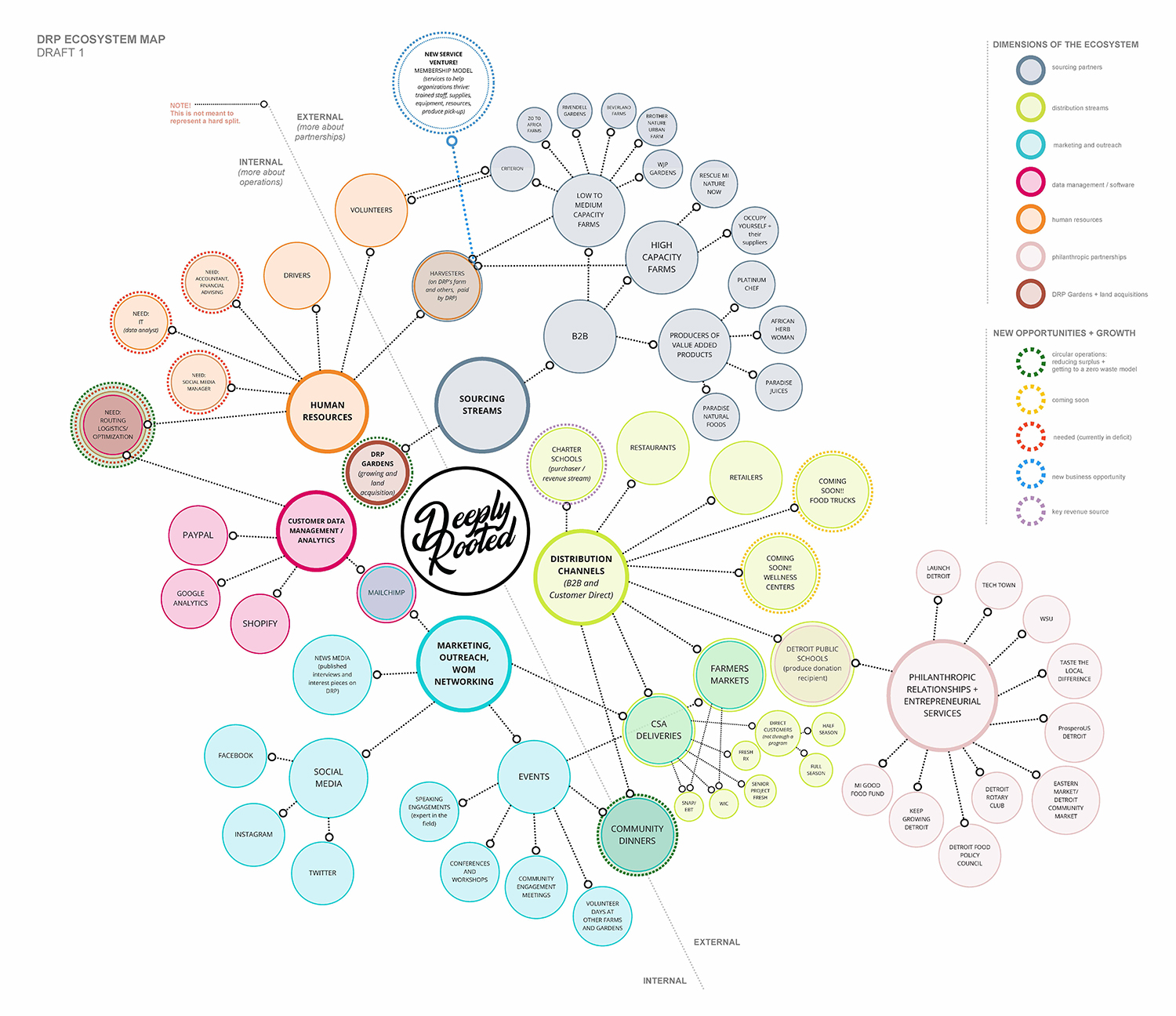
Information from the data mapping exercise was combined with insights that I gathered through numerous conversations with Dazmonique as I developed an ecosystem map that visualized the extent of her impact. Creating this map also helped to identify a few key areas of opportunity and growth.
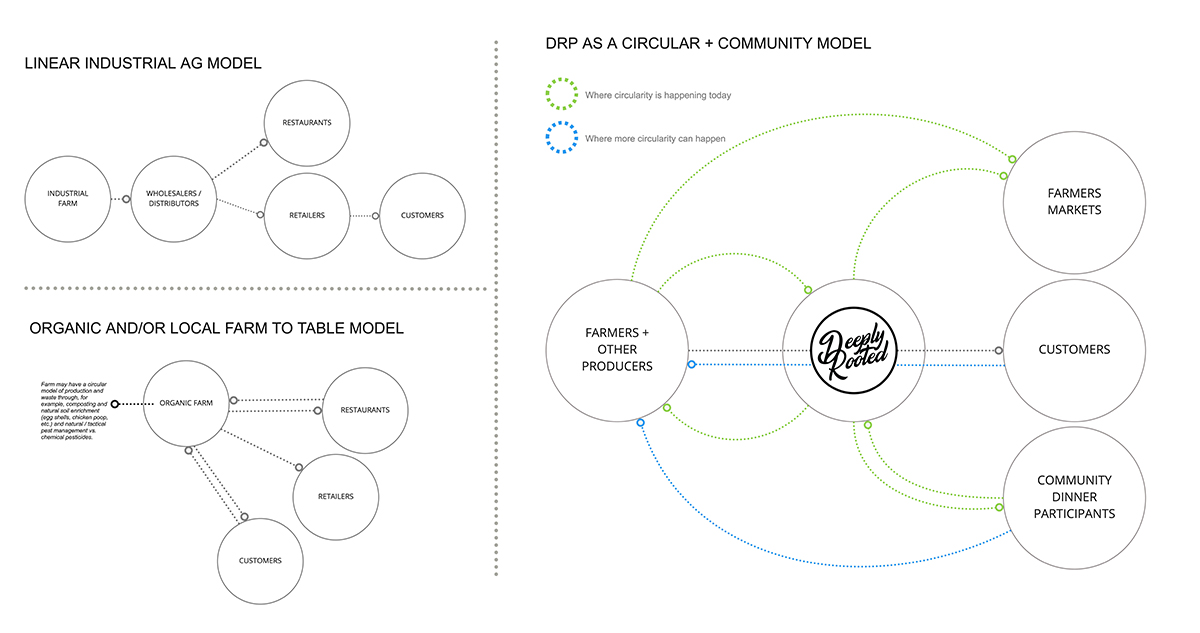
We also visualized how her business model is different from traditional agricultural models and organic agricultural models, and where she could even push further to be more circular.
Highlight 2: Raising DRP’s Visual Profile
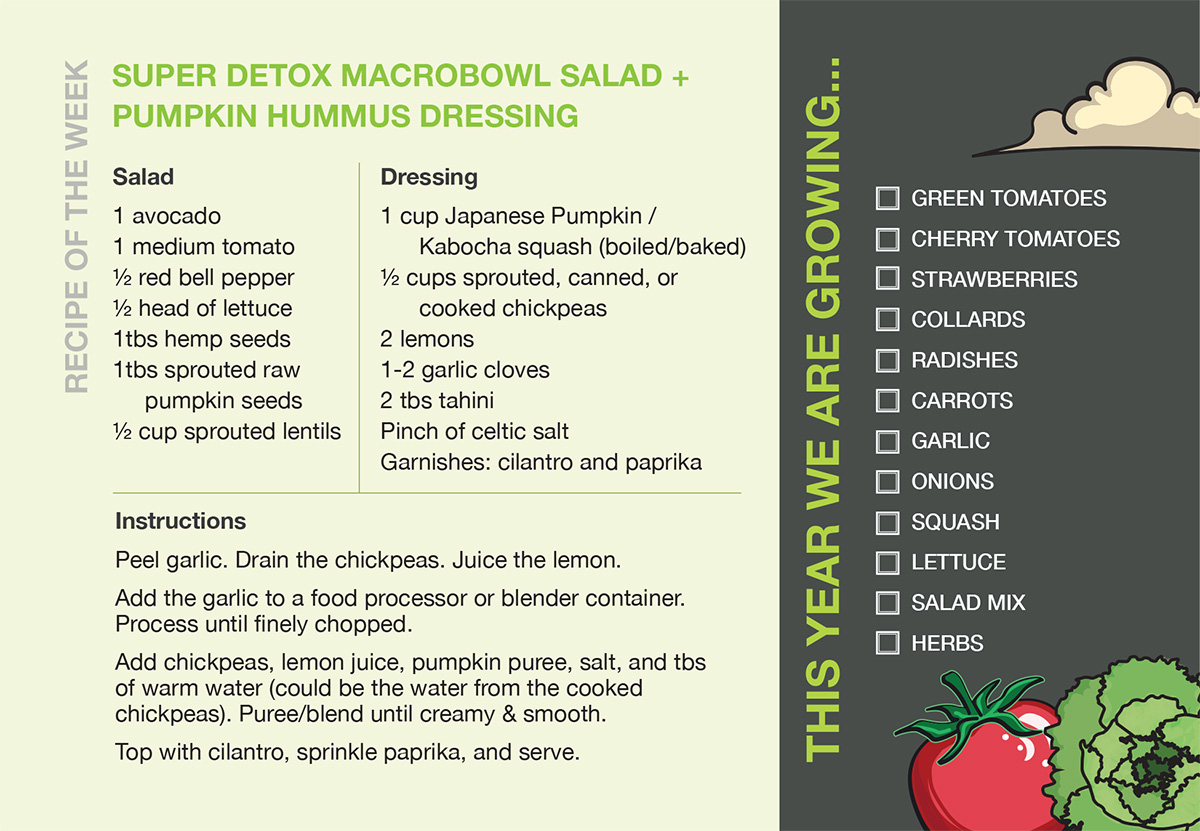
One of DRPs immediate needs was a strong graphic identity for her delivery van, which was unrecognizable from other work vans on the road. As a mobile billboard, the DRP delivery van presented an exciting opportunity to use design to raise awareness. The original designs were created by Ben Davis, focus-grouped and the best one was refined by me for production. We used the same graphic later for promotional cards, reinforcing this colorful and dynamic personality for the brand.


Highlight 3: Digital Ideation for Scaling Operations and Logistics
We developed an initial wireframe for a mobile app to help support and scale DRP’s operations. However, we put this work on hold because Dazmonique was concerned that, without the human resources to manage a new platform, it could become an unnecessary burden on her. Also, after consulting with a developer, we also collectively determined that a mobile app would be too expensive to develop with the funds we have available at the time.
Our most recent work is funded by The Ford Foundation, through a 2024 Design for Social Impact student contest award. Design students created a winning proposal to transform one of DRP’s vacant lots into a community space equipped with a shipping container that will house 3 fresh produce vending machines. The site will be landscaped and will also include a patio slab, seating, and parking.
We are also developing an app that will help DRP manage both inventory and routing. The routing platform, called Solidarity Pathways, was developed by Kwame Porter Robinson, faculty in WSU’s business school, Department of Technology, Information Systems, and Analytics. Solidarity Pathways is part of Robinson’s research into how information systems can create greater social and economic sustainability and strengthen urban entrepreneurial ecosystems, for example, by lessening entrepreneurs’ reliance on tech service subscriptions.
I took Solidarity Pathways and started designing it for mobile, while also envisioning how to incorporate other logistical information like customer and supplier orders, storage, and managing vending machine configurations, transactions, restocking schedule and more. More to come…

 siobhan gregory